Business Context & Problem
Social applications require more than basic content management. User relationships, privacy rules, social interactions, notifications, and activity presence need to work together while keeping the application responsive and synchronized in real time.
System Solution
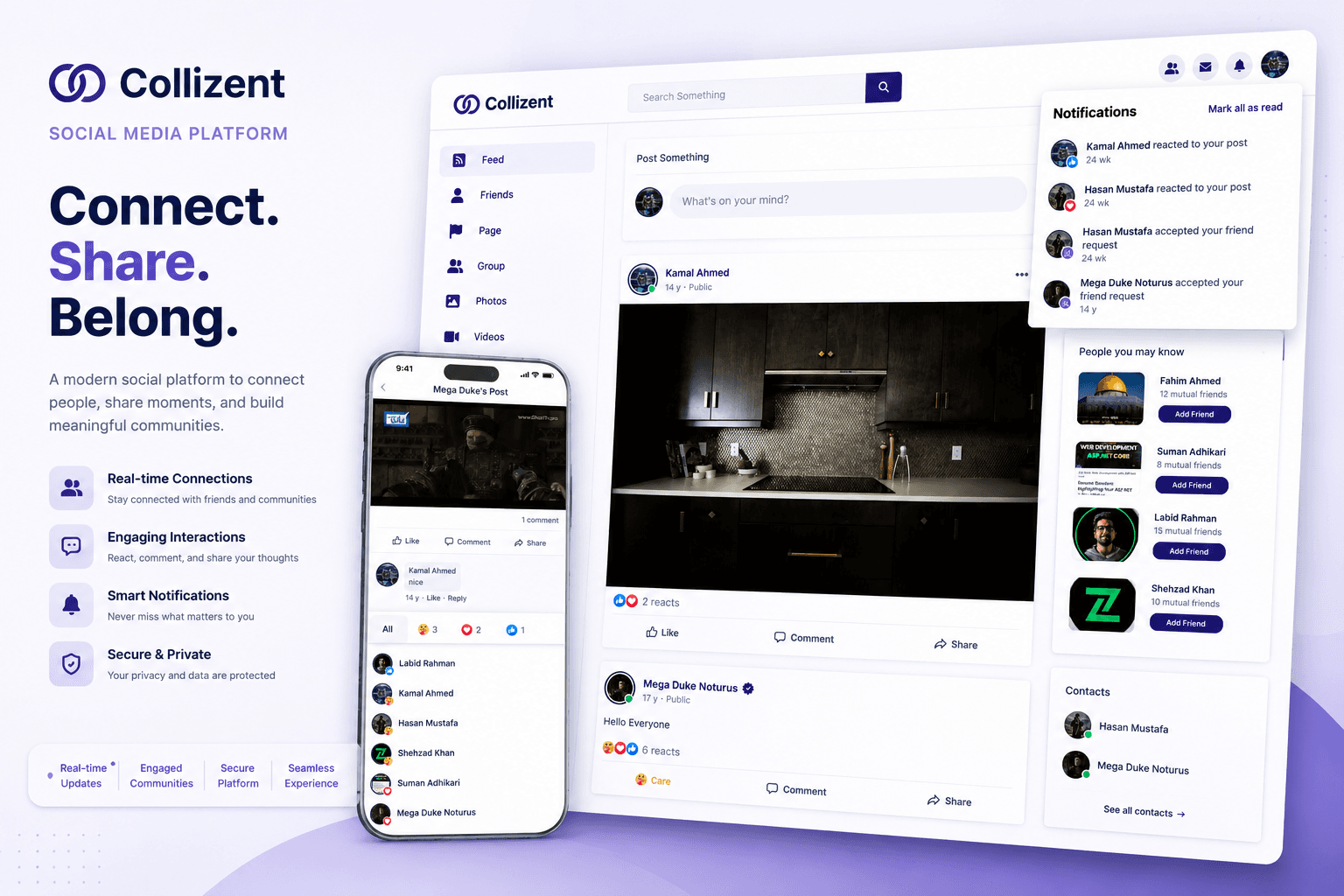
Built a full-stack social networking platform using Next.js and Django, combining REST APIs for standard application workflows with Django Channels and WebSocket-based communication for real-time notifications and user activity updates.
Architecture & Engineering Execution
The platform uses Next.js, React, TypeScript, and Tailwind CSS for the frontend, with Django and Django REST Framework powering the backend APIs. Django Channels and Daphne provide the real-time communication layer, while Redis supports the real-time infrastructure. Axios is used for frontend API communication, and JWT-based authentication handles authenticated application access. The application is containerized using Docker.
Key Engineering Challenges
Real-Time Communication
Social events such as notifications and activity status need to reach connected users without requiring repeated page refreshes.
Implemented Django Channels with WebSocket communication and Daphne to provide a real-time communication layer alongside the standard Django application.
Enabled the platform to deliver real-time social activity and notification updates to connected users.
Social Relationship Management
Friend requests and relationships require consistent state transitions between users while preventing invalid relationship states.
Built workflows for sending, receiving, accepting, and managing friend relationships through the backend API and frontend interaction flows.
Established a persistent social graph that supports the platform's user-to-user interactions.
Post Privacy & Content Access
Social content may have different visibility requirements depending on the relationship between users and the privacy configuration of the post.
Integrated post privacy into the content access workflow so that post visibility is evaluated before content is exposed to users.
Provided users with control over the audience that can access their published content.
Notifications & Social Events
Reactions, comments, friend requests, and other social events can generate user notifications that need to be processed and delivered efficiently.
Connected social interaction events with the notification system and real-time communication layer to deliver relevant updates to connected users.
Created a more responsive notification experience where users can receive social activity updates without manually refreshing the application.
Full-Stack Application Architecture
The platform requires multiple application concerns including authentication, REST APIs, real-time communication, social workflows, and frontend state management to operate together.
Separated the application into a Next.js frontend and Django backend, using REST APIs for standard operations and WebSockets for real-time functionality, with both services containerized through Docker.
Created a modular full-stack architecture that separates frontend presentation, backend business logic, API communication, and real-time functionality.
Core System Capabilities
- User authentication
- User profiles
- Friend requests
- Friend relationships
- Social activity feed
- Post creation and management
- Post privacy controls
- Comments
- Post reactions
- Real-time notifications
- Real-time activity status
- People discovery
- Contacts and social connections