When engineering teams discuss cloud cost optimization, the conversation usually revolves around infrastructure.
- Smaller instances
- Autoscaling
- CDN optimization
- Database tuning
- Caching layers
While these strategies are important, many organizations overlook one of the most impactful areas of optimization:
API Architecture.
Every API response consumes resources. Data must be queried, processed, serialized, transferred across networks, parsed by clients, and stored in caches. When applications continuously send unnecessary data, cloud costs increase even if the infrastructure itself is perfectly optimized.
This is where GraphQL can create measurable business value.
Beyond developer experience and frontend flexibility, GraphQL can significantly reduce bandwidth consumption, lower infrastructure load, and improve overall system efficiency.
Understanding the Cost of Data Transfer
Every API request generates costs across multiple layers of the system.
- Network bandwidth
- API gateway processing
- Application server CPU usage
- Memory consumption
- Database queries
- CDN traffic
Many developers focus on the number of requests being made, but the size of those requests and responses often has an equally important impact on infrastructure costs.
If an application serves millions of requests every month, even a small reduction in payload size can translate into substantial savings.
What is Over-Fetching?
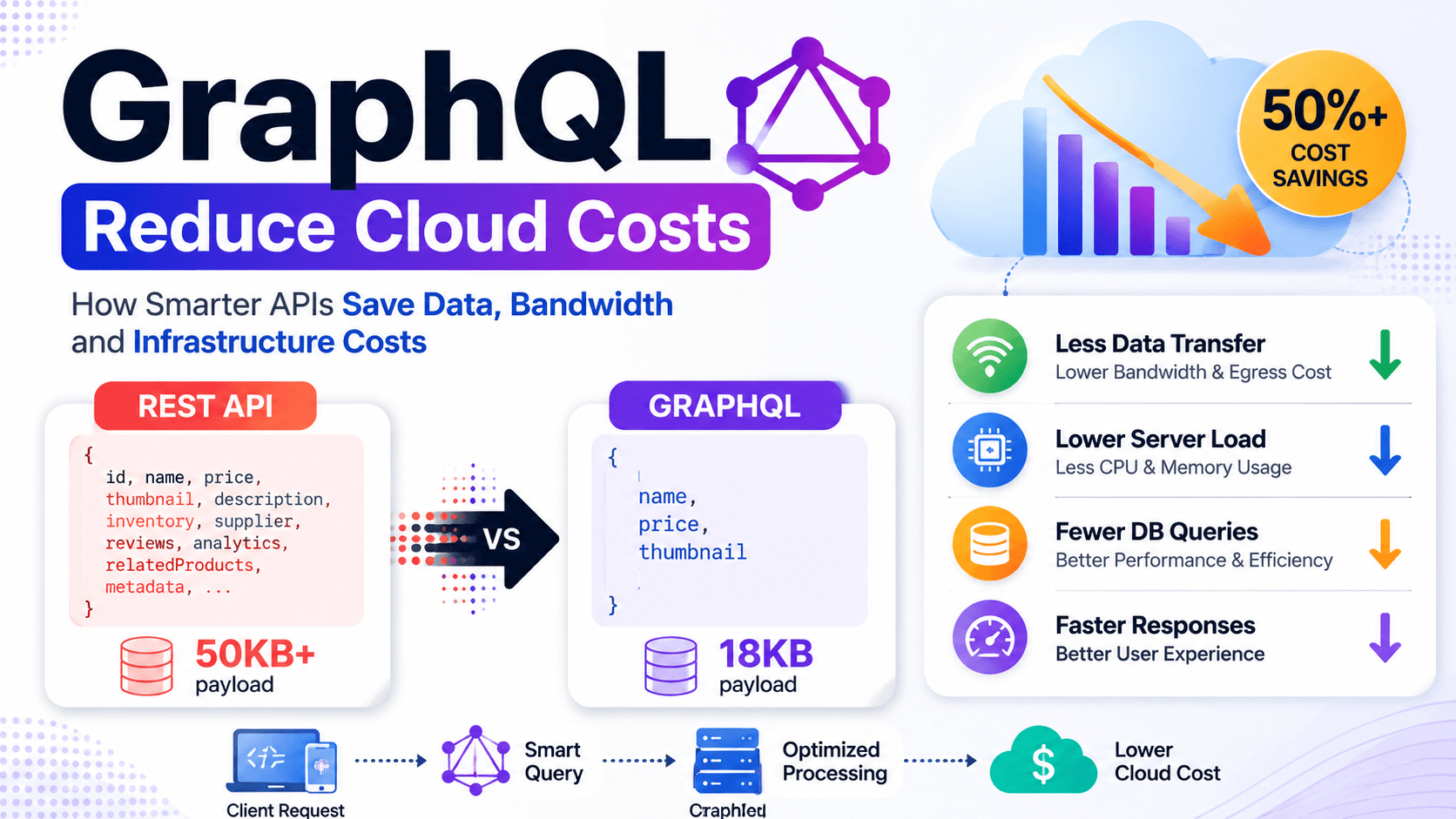
One of the most common limitations of traditional REST APIs is over-fetching.
Suppose a product listing page only requires:
- Product Name
- Price
- Thumbnail
However, the API returns a much larger payload:
{
  "id": 1,
  "name": "Product",
  "price": 99,
  "thumbnail": "...",
  "description": "...",
  "inventory": 500,
  "supplier": "...",
  "reviews": [...],
  "relatedProducts": [...],
  "analytics": {...}
}
The frontend uses only three or four fields, but the backend sends everything.
This extra information consumes bandwidth, processing power, and memory despite providing no value to the current user experience.
How GraphQL Solves Over-Fetching
GraphQL allows clients to request exactly the data they need.
query {
  products {
    name
    price
    thumbnail
  }
}
The response contains only the requested fields.
{
  "data": {
    "products": [
      {
        "name": "Product",
        "price": 99,
        "thumbnail": "..."
      }
    ]
  }
}
No unnecessary metadata. No unused fields. No wasted bandwidth.
Understanding Under-Fetching
REST APIs often introduce a second problem called under-fetching.
A single page may require multiple endpoints:
/users
/users/1/orders
/users/1/preferences
/users/1/subscription
Each request adds latency and infrastructure overhead.
GraphQL can retrieve related data through a single request.
query {
  user {
    profile
    orders
    preferences
    subscription
  }
}
Fewer requests often lead to better performance and reduced operational costs.
Where Cloud Cost Savings Come From
1. Reduced Bandwidth Usage
Smaller responses mean less data transfer.
This directly impacts:
- CDN costs
- Network egress charges
- API gateway usage
- Mobile network consumption
2. Lower Server Load
Every response requires computation.
The server must:
- Fetch data
- Serialize JSON
- Allocate memory
- Transmit responses
Smaller payloads generally require fewer resources.
3. Better Database Efficiency
Well-designed GraphQL schemas can reduce unnecessary database access.
Resolvers can be optimized to fetch only relevant fields, improving query efficiency and reducing load on backend services.
A Simple Cost Example
| Metric | REST API | GraphQL |
|---|---|---|
| Average Response Size | 50 KB | 18 KB |
| Monthly Requests | 10 Million | 10 Million |
| Total Data Transfer | 500 GB+ | 180 GB+ |
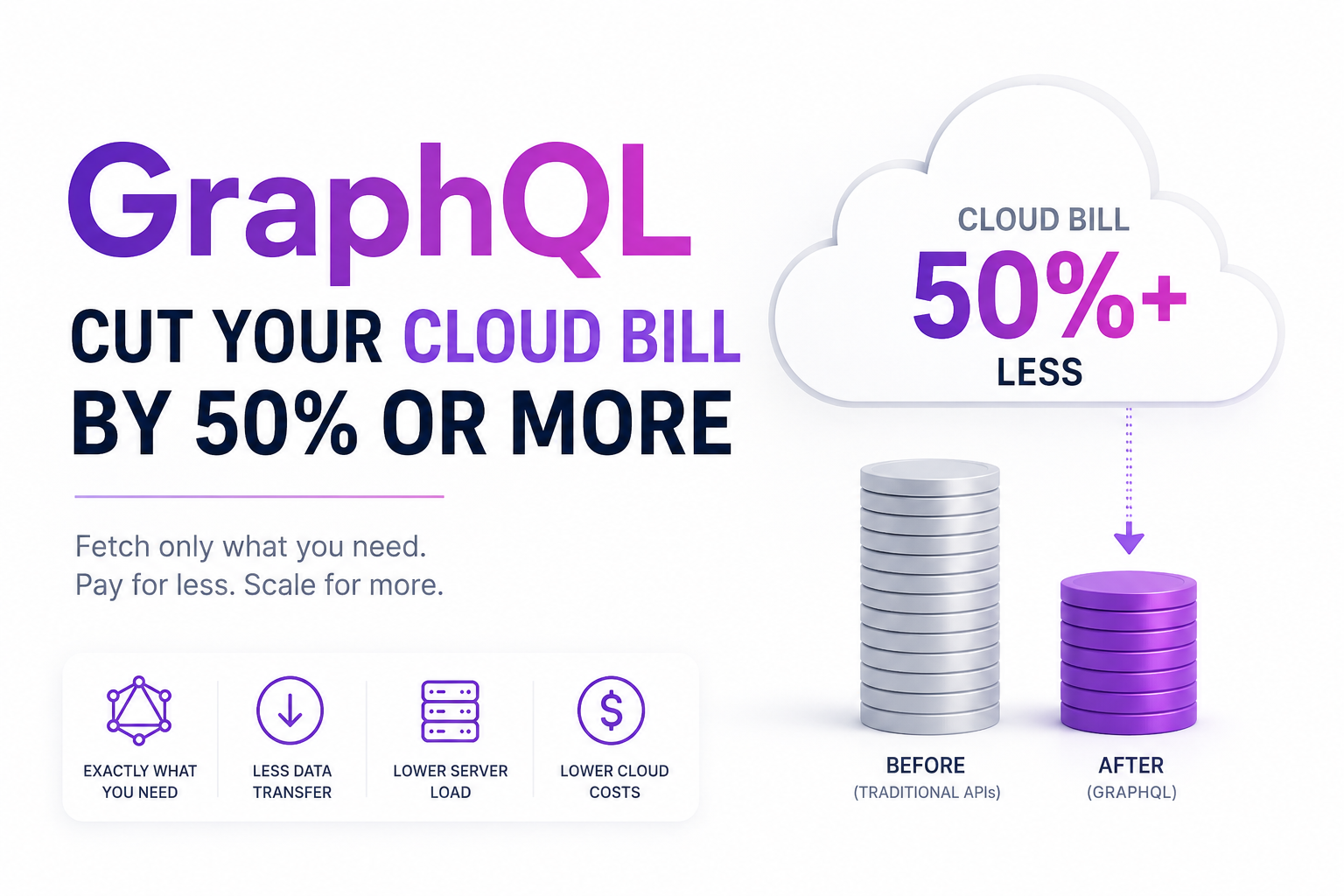
In this simplified example, GraphQL reduces transferred data by more than 300 GB every month.
At scale, this reduction can have a meaningful impact on infrastructure spending.
The N+1 Query Problem
GraphQL is not automatically efficient.
One of the most common challenges is the N+1 query problem.
Users
 └─ Orders
     └─ Items
If resolvers are poorly designed, a single GraphQL request may trigger hundreds of database queries.
This can increase infrastructure costs rather than reduce them.
Common Solutions
- DataLoader
- Batching
- Caching
- Resolver optimization
When GraphQL Might Increase Costs
GraphQL can become expensive if implemented incorrectly.
- Deep nested queries
- Unlimited query depth
- Poor schema design
- Missing cache layers
- Inefficient resolvers
Like any technology, GraphQL requires thoughtful architecture.
GraphQL vs REST
| Area | REST | GraphQL |
|---|---|---|
| Over-Fetching | Common | Minimal |
| Under-Fetching | Common | Rare |
| Payload Efficiency | Lower | Higher |
| Client Flexibility | Limited | High |
| Implementation Complexity | Lower | Higher |
Best Practices for Cost Optimization
- Limit query depth.
- Use persisted queries.
- Implement DataLoader.
- Cache expensive operations.
- Monitor resolver performance.
- Track bandwidth consumption.
- Measure p95 and p99 latency.
Conclusion
GraphQL is often promoted as a frontend-friendly API technology, but its impact extends far beyond developer experience.
By reducing over-fetching, minimizing network transfer, and improving data retrieval efficiency, GraphQL can become a powerful tool for cloud cost optimization.
However, savings are not guaranteed by the technology itself.
The real benefits come from thoughtful architecture, efficient schema design, proper caching, and continuous performance monitoring.
When implemented correctly, GraphQL can help organizations build systems that are not only flexible and scalable but also significantly more cost efficient.
Zisanur Haque
Technical Product Architect & Product Engineer