Introduction
As software platforms grow, supporting multiple tenants, services, and business domains often introduces significant architectural complexity.
A common challenge in large-scale frontend systems is maintaining routing structures, page hierarchies, and UI consistency across multiple services while keeping the codebase maintainable.
Many teams initially organize applications around service-specific routes and page structures. While this approach works for smaller projects, it often becomes difficult to scale as the platform expands.
The Traditional Approach
Consider a platform supporting multiple business services:
/electronic-shop
/gift-shop

/electronic-categories
/gift-categories

/electronic-product
/gift-product
Each service introduces its own route hierarchy, page implementations, layouts, and supporting components.
Over time this leads to:
- Route duplication
- Repeated page structures
- Maintenance overhead
- Inconsistent user experiences
- Longer development cycles
The problem is not necessarily the routing system itself. The real challenge is coupling business domains directly to frontend page structures.
Rethinking the Architecture
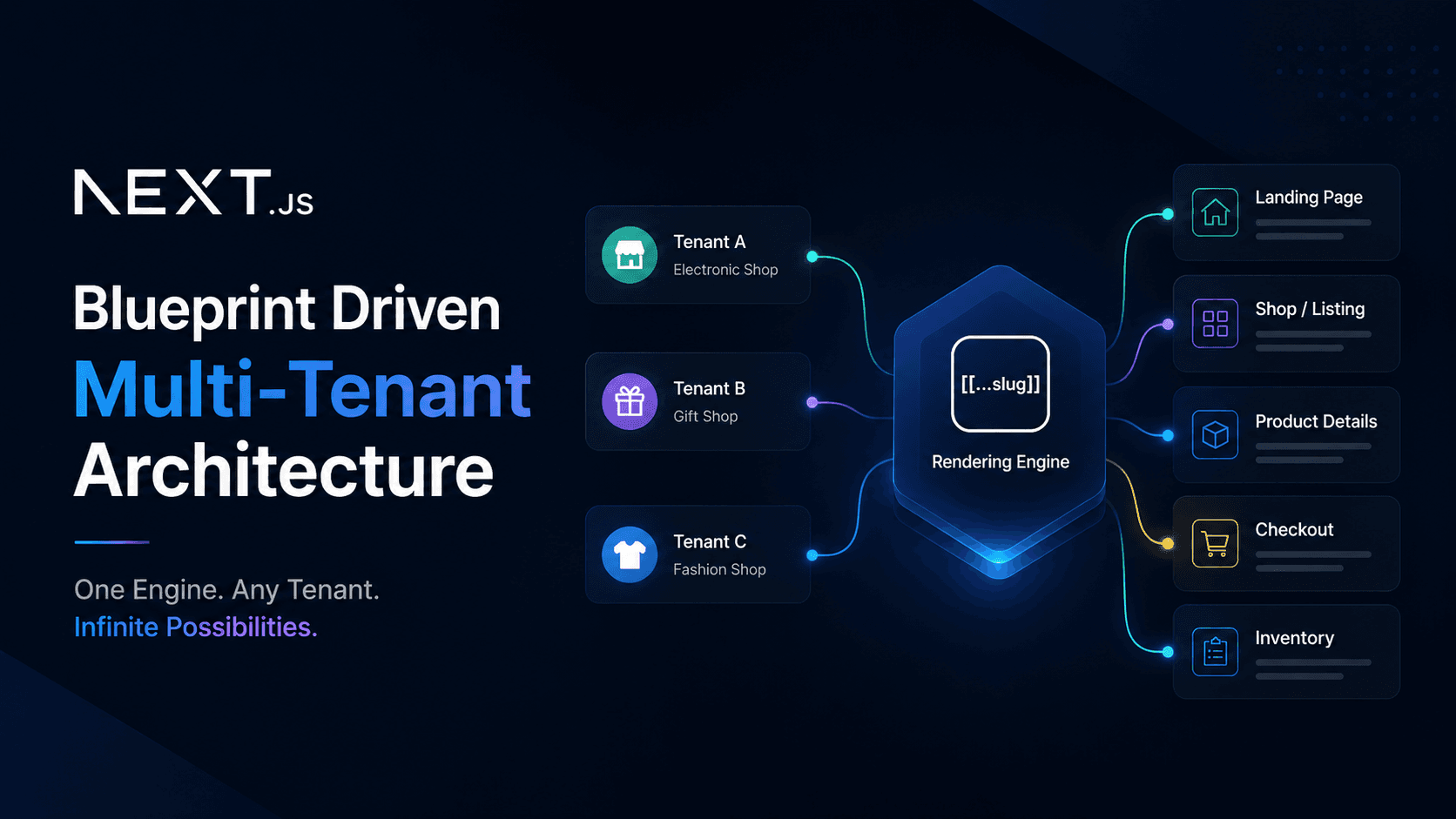
Instead of building the frontend around service-specific routes, a more scalable approach is to build around page capabilities and rendering blueprints.
The core idea is simple:
- Routes identify intent
- Blueprints define structure
- Configuration drives rendering
Rather than creating dedicated page implementations for every service, a shared rendering engine becomes responsible for composing experiences dynamically.
Using Next.js Dynamic Routing
Next.js provides optional catch-all routing through:
app/[[...slug]]/page.tsx
This route acts as a centralized entry point for page resolution.
Instead of maintaining dozens of service-specific page files, the routing layer forwards requests into a blueprint resolution process.
The Blueprint Driven Rendering Model
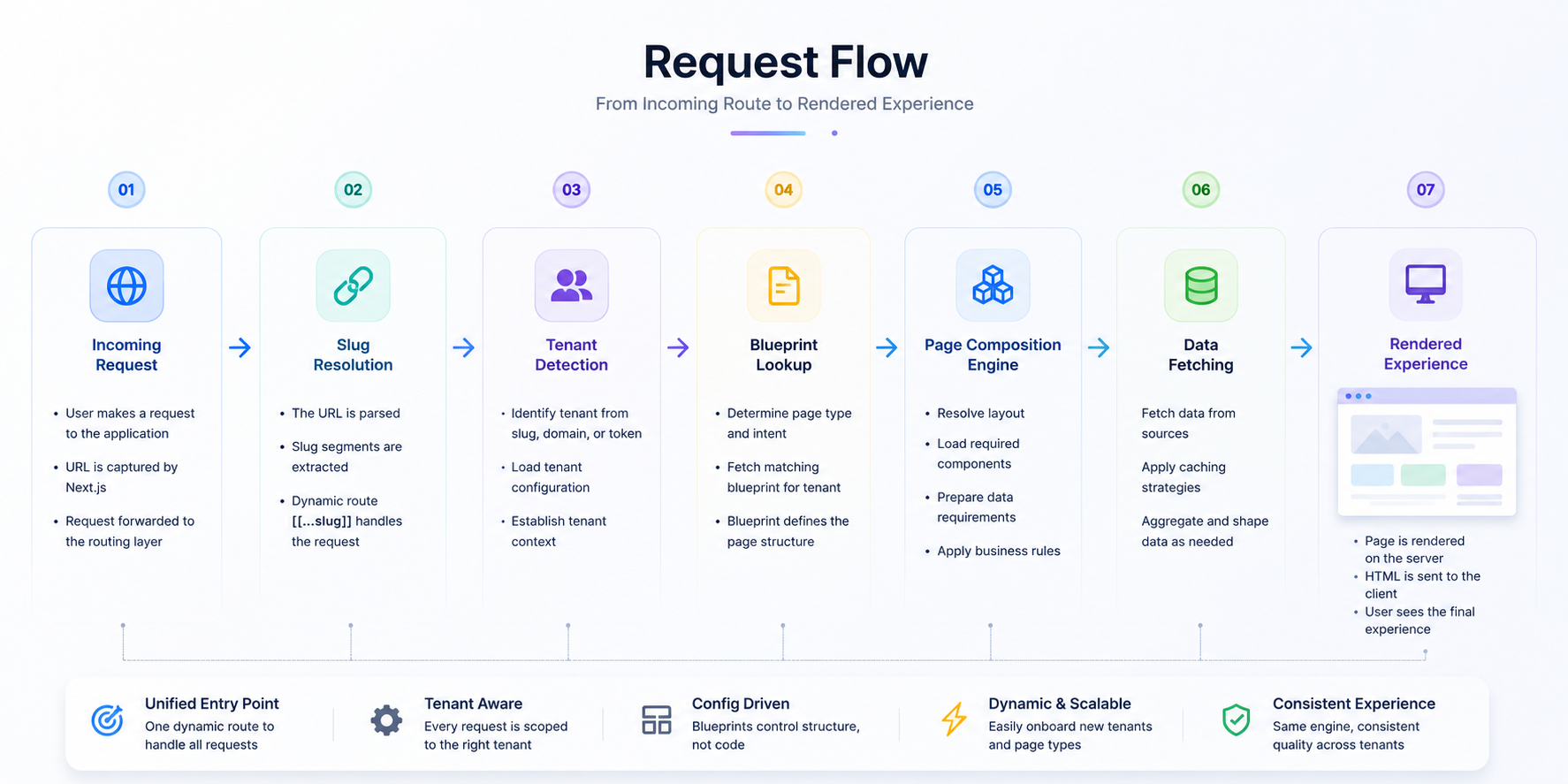
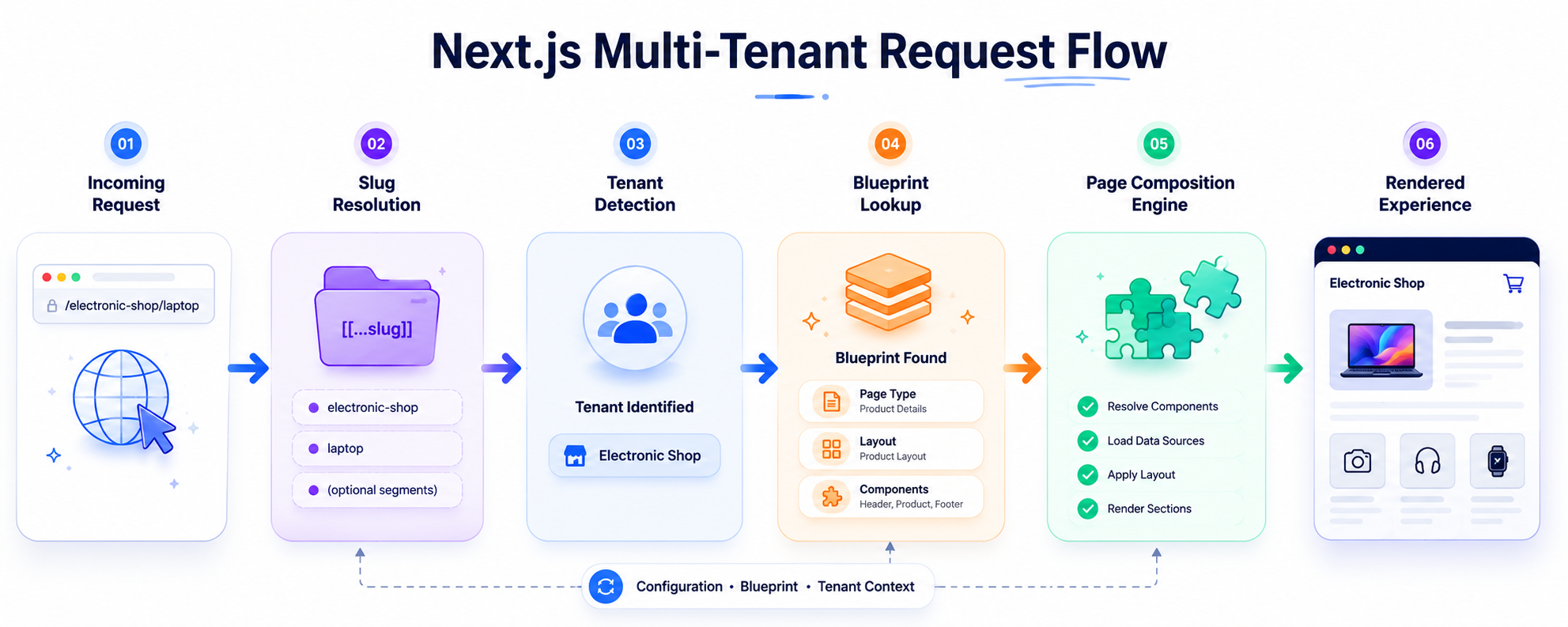
When a request arrives, the system evaluates several pieces of information:
- Tenant context
- Current route
- Page type
- Business configuration
Based on this information, the application resolves a blueprint.
A blueprint acts as a contract describing how the page should be assembled.
For example, a blueprint may define:
- Layout structure
- Section ordering
- Component composition
- Data sources
- SEO configuration
- Feature availability
The rendering engine then dynamically builds the page using these definitions.
Request Flow
This separation of concerns allows routing, configuration, and presentation layers to evolve independently.
Advantages of a Blueprint-Based Architecture
1. Reduced Code Duplication
Instead of creating similar page implementations repeatedly, reusable rendering logic can be shared across multiple services and tenants.
2. Faster Tenant Onboarding
New tenants can often be introduced through configuration changes rather than new page development.
3. Consistent User Experience
A centralized rendering model helps maintain visual and behavioral consistency across the platform.
4. Simplified Maintenance
Updating a shared blueprint or rendering engine can immediately improve multiple services simultaneously.
5. Better Scalability
As the number of tenants grows, the complexity curve remains significantly flatter compared to route-per-service architectures.
Relationship with Multi-Tenant Backend Systems
One of the biggest benefits of this architecture is how naturally it aligns with multi-tenant backend designs.
Tenant-specific configurations stored in the database can directly influence frontend rendering behavior without requiring code changes.
This creates a powerful relationship between:
- Tenant configuration
- Frontend rendering
- Business capabilities
The result is a highly adaptable platform architecture capable of supporting different business domains through a unified codebase.
Tradeoffs and Considerations
Like any architectural pattern, blueprint-driven systems introduce their own challenges.
- Higher initial complexity
- More sophisticated configuration management
- Additional validation requirements
- Greater emphasis on documentation
Teams should carefully evaluate whether the additional abstraction is justified by the scale and variability of the platform.
For smaller applications, traditional route structures may remain the simpler and more practical solution.
Conclusion
Building scalable multi-tenant applications is rarely about creating more routes or more pages. It is about managing complexity as systems evolve.
By combining Next.js dynamic routing with blueprint-driven page composition, teams can create architectures that are easier to scale, maintain, and extend over time.
The most valuable architectural decisions are often those that reduce future complexity rather than simply solving today's requirements.
As platforms continue to grow, investing in thoughtful abstraction layers can provide significant long-term engineering benefits.
Zisanur Haque
Technical Product Architect & Product Engineer